Back to School Alphabet Doodle
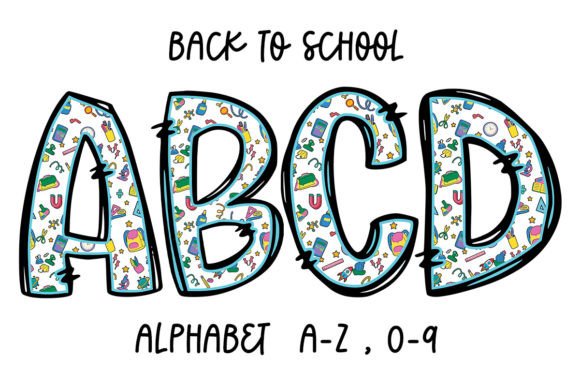
Back to School Alphabet Doodle is a thoughtfully crafted digital alphabet set designed for real-world creative work—not just decoration, but utility. It’s not a generic font or clipart pack; it’s a cohesive collection of 26 uppercase letters and numbers, each hand-drawn with relaxed, approachable charm—think chalkboard sketches meets modern sublimation readiness. Every letter balances personality with clarity: rounded edges, subtle texture hints, and intentional spacing that holds up whether printed tiny on a name tag or scaled large for a classroom banner.
This isn’t an SVG or editable vector file—it’s a set of 300 DPI PNGs with transparent backgrounds, delivered as ready-to-use files. That means no wrestling with layers, no tracing over rasterized outlines, and no guesswork about print quality. You open the file, place it in your design software, and go. That practicality is why educators use it for student name cards, small business owners apply it to custom tumblers for back-to-school promotions, and bloggers embed it into downloadable planners without compromising resolution.
Creative Uses That Go Beyond the Obvious
Because these doodle-style letters are both playful and legible, they adapt cleanly across formats and audiences. A homeschool parent might layer “A” through “Z” onto a printable spelling chart—each letter visually anchoring vocabulary words with consistent tone and weight. Meanwhile, a boutique stationery designer could isolate individual letters to build monogrammed teacher appreciation cards, pairing “M” for Ms. Chen with a watercolor wash background and a short handwritten note.
Sublimation users especially benefit from the clean transparency and high-resolution output. Try printing “S” and “T” onto ceramic mugs for a “Study Time” theme, or arrange “B”, “O”, and “O” into a bold trio on a tote bag for school supply kits. Since every file is pre-optimized at 300 DPI, there’s no pixelation when heat-pressed onto polyester blends—even on curved surfaces like phone cases or coasters.
For Educators: Clarity With Character
In classrooms, visual consistency supports learning—and this alphabet delivers it without sacrificing warmth. Use the full set to label learning centers (“Reading Corner”, “Math Station”) with printed and laminated cards. The doodle aesthetic feels inviting, not infantilizing—ideal for upper elementary or middle school where students respond better to authenticity than cartoonishness. Pair letters with simple icons (a pencil for “P”, a globe for “G”) to reinforce phonics or geography units without cluttering the design.
For special education settings, the strong outlines and generous negative space improve readability for learners with visual processing differences. You’re not just adding decoration—you’re building accessibility into your materials from the start.
For Small Businesses & Makers: Brand-Aligned Flexibility
If you sell custom school-themed merchandise, this set gives you speed *and* cohesion. Instead of sourcing mismatched fonts or paying for extended licenses, you get one unified style that works across product types: vinyl decals for lockers, iron-on transfers for spirit wear, or even laser-cut wood signs for classroom doors. Because all letters share the same line weight, texture treatment, and baseline alignment, your brand stays recognizable—even when applied across wildly different substrates.
Real example: A Minnesota-based Etsy shop used the “R”, “E”, and “A” letters to create a “Read Every Day” wall plaque for kindergarten teachers. They added a soft drop shadow in Canva before printing onto birch plywood—no design expertise required, just smart file use.
For Bloggers & Content Creators: Visual Storytelling Made Simple
Bloggers covering back-to-school prep often struggle to illustrate checklists or themed roundups without falling into cliché. Back to School Alphabet Doodle solves that by offering immediate visual shorthand. Embed “L” next to “Lunchbox Essentials”, “N” beside “Notebook Recommendations”, and “T” with “Teacher Gift Ideas”. Readers scan faster, retain more, and associate your content with thoughtful, on-brand visuals—not stock photos.
You can also repurpose single letters as social media post anchors: Instagram carousels titled “5 Things Starting with S” (Supplies, Schedules, Snacks, Smiles, Systems), each slide featuring one bold letter alongside concise tips. Consistency across posts builds recognition—and saves hours of redesigning headers each week.
Design Tips for Stronger Results
- Respect the transparency. Don’t add white backgrounds unless your printer or platform requires it—doing so defeats the purpose of the built-in transparency and can cause misalignment on layered designs.
- Test scale early. While the files hold up well at size, letters under 0.5 inches tall may lose subtle detail on fabric or textured paper. For tiny applications (like badge reels), stick to bolder letters like “O”, “H”, or “X”.
- Pair intentionally. These doodles shine alongside clean sans-serifs (for contrast) or muted earth tones (to ground the playfulness). Avoid competing textures—e.g., don’t overlay on busy patterns unless you’re aiming for intentional collage energy.
- Stay audience-aware. Middle schoolers appreciate subtle wit (“Q is for Question Everything”), while preschool teachers may prefer simpler pairings (“A is for Apple”). Let your end user guide tone—not the trend.
No Editing? No Problem.
The fact that these aren’t editable SVGs isn’t a limitation—it’s a feature for focused workflow. If you’re time-crunched (and who isn’t during back-to-school season?), knowing exactly what you’ll get—no missing fonts, no broken links, no export hiccups—means less troubleshooting and more making. You’re not buying raw material to sculpt from scratch. You’re buying a reliable, field-tested tool that does one thing very well: help ideas land clearly, warmly, and professionally.
Whether you're pressing “D” onto a denim backpack for a new grad, building a digital newsletter header around “W” for “Welcome Back”, or framing “Z” as part of a student’s “Zoology Week” display—this set meets you where you are. It doesn’t ask you to be a designer first. It asks you to know your goal, pick the right letter, and move forward.